Manufacturing services · Sialkot, Pakistan

Sublimation Printing

Full-color, edge-to-edge prints that become part of the fabric. Our in-house sublimation line prints rash guards, shorts and compression wear for brands, gyms and teams.

Screen printing press printing a design

Short answer: Sublimation printing transfers dye into polyester fibers using heat and pressure. The dye turns to gas and bonds with the fabric, so the print can't crack, peel or wash off. It's the standard method for fightwear because it handles unlimited colors, all-over designs and high stretch. Rumbling Fit prints in-house in Sialkot.

How sublimation works

  1. Artwork is printed in reverse onto transfer paper with sublimation inks, panel by panel, sized to each garment size.
  2. The paper is pressed onto fabric on a heat press or calender at around 190–205 °C.
  3. The dye turns to gas and bonds with the polyester fibers.
  4. Panels are cut and sewn into the finished garment, with seams aligned to the print.

Because the color is inside the fiber, a sublimated print has no surface feel at all. You can't feel where the print starts and stops, it stretches with the garment, and it breathes like the unprinted fabric.

Why fightwear brands choose sublimation

  • Unlimited colors. Gradients, photos and complex patterns cost the same as a single color.
  • All-over coverage. Edge-to-edge designs, including sleeves and side panels.
  • Durability. No cracking or peeling, even after long training sessions and frequent washing.
  • No minimum per color. Ideal for small batches and multiple colorways.
  • Comfort. Nothing on the surface to rub on the mat.

Limits you should know

  • Polyester only. Sublimation needs synthetic fibers. Fabrics are typically high-polyester blends with spandex. Cotton doesn't take sublimation dye.
  • Light base fabric. The ink is transparent and printed onto white or light fabric. You can't sublimate white onto black fabric; we print the black instead.
  • White crease lines. Fabric that folds under the press can leave thin white lines. Careful pressing prevents this; we check every panel.
  • Color differences. Screens are RGB; dyes are not. We match to Pantone references and recommend a strike-off for brand colors.

Our blog post on common sublimation print defects shows what to look for in a sample.
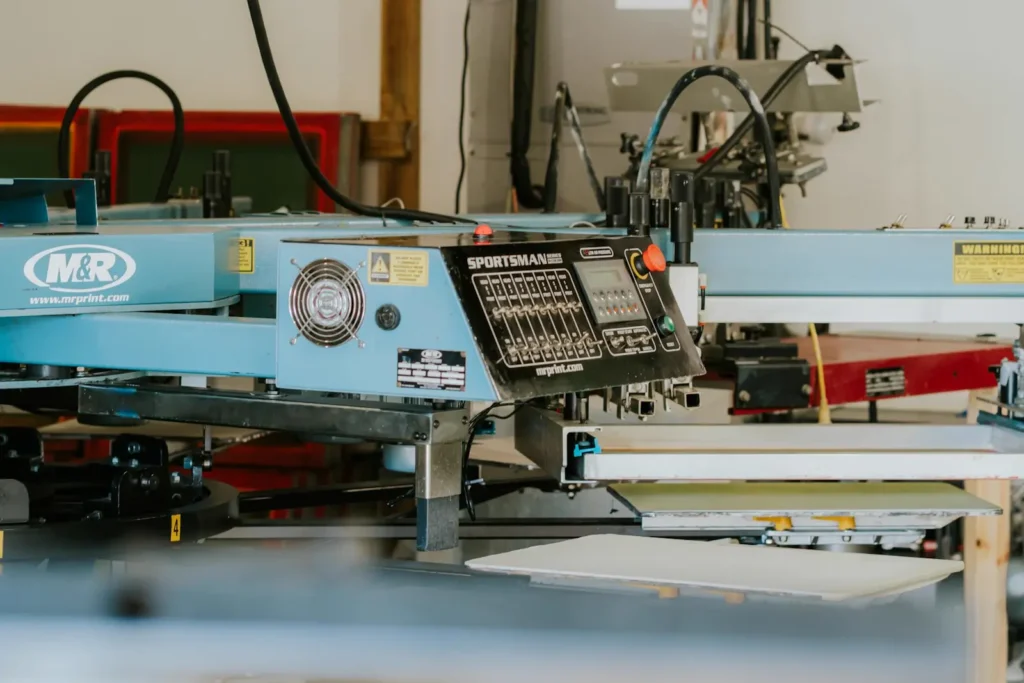
Industrial screen printing machine in a workshop
Panels are printed and pressed in-house before cutting and sewing.

Sublimation vs other decoration

MethodBest forNot ideal for
SublimationAll-over and multi-color designs on polyesterCotton, dark base fabrics
Screen printingBold 1–4 color logos, cotton teesPhotographic images, tiny runs with many colors
EmbroideryLogos on hoodies, caps, waistbandsHigh-stretch rash guard panels
DTF transferDetailed logos on any fabric, short runsLarge all-over areas

Products we sublimate

Rash guards, MMA fight shorts, grappling shorts, compression wear, performance tees, singlets and team kits.

Preparing artwork for sublimation

  • Send vector files (AI, PDF, SVG) or high-resolution raster (300 dpi at print size).
  • Use CMYK or give Pantone references for brand colors.
  • Keep text and logos at least 1.5 cm from seams.
  • Avoid placing thin lines across high-stretch areas such as the shoulders.
  • Ask us for our pattern templates so you can design directly on the panels.

Get a quote

Send your design, logo or reference. We reply within one working day.

  • MOQ 10 pieces per design
  • Samples in 7 to 9 days
  • Bulk in 30 to 45 days (air)
  • 50,000+ pieces a month capacity
  • Terms: 50% advance, 50% before shipment
FAQ

Sublimation Printing: common questions

Sublimated prints are very colorfast because the dye is in the fiber. Washing inside-out in cold water and avoiding tumble drying keeps colors brightest for longest.

No. Sublimation needs polyester-rich fabric. For cotton we use screen printing, DTF or embroidery.

We match to Pantone references and can produce a strike-off before sampling for color-critical work. Exact matches vary slightly between fabrics.

The same as all orders: 10 pieces per design.

Send your design. Get a quote in 24 hours.

Share a sketch, tech pack, reference photo or just your logo. We reply within one working day with options, a sample plan and pricing for your quantities. Minimum order: 10 pieces per design.